
In the Classical epoque public interest and public life was at its peak evolution and occupied the center attention in the life of citizens in a polis. A free Greek would spend the most of his time out in the city, returning home only to satisfy basic needs (mainly eat and sleep). Walkways were filled with people of all races and different social status, in agora and stoa merchants trading was flourishing, people were engaging in philosophical discussions, deals and bets were made, cockfights were held, teachers worked with students. Polises were investing most of their resources to build monumental constructions for the public, such as temples, altars, theaters, etc. Even the richest citizens were dedicating little attention in private houses, building modest residences for personal use.
The construction of many houses employed walls of sun-dried clay bricks or wooden framework filled with fibrous material such as straw or seaweed covered with clay or plaster, on a base of stone which protected the more vulnerable elements from damp. The roofs were probably of thatch with eaves which overhung the permeable walls. The roofing material for the substantial house was tile.
Rooms were heated with portable larks. The only permanent fireplace was in the oikos. The smoke from fireplace was thrown out through a hole in the wall, positioned under the ceiling, into the chimney made as a straight tall chamber. Often houses had at least one bathroom, made as a deepening in the ground covered with stone, in the shape of a lounge chair.
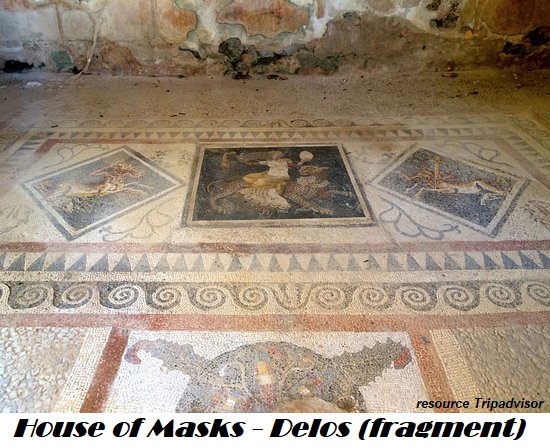
Internal decorations in the classical period were modest. Walls were made of sun-dried clay bricks covered with clay or plaster. These were afterward painted, usually by dividing the surface into three horizontal strikes, detached by an in-depth line, using the combination of red with yellow and white. The floor was decorated with mosaic in colored pebbles or chipped stones, illustrating mythological scenes, animals, fantastic characters, and classical style ornamental motives. Floors on the upper levels were made of wooden boards or clay. A high attention was given to the decoration of the internal patio, usually paved with stone slabs, while in the center of the courtyard and on its corners were placing altars to the gods.
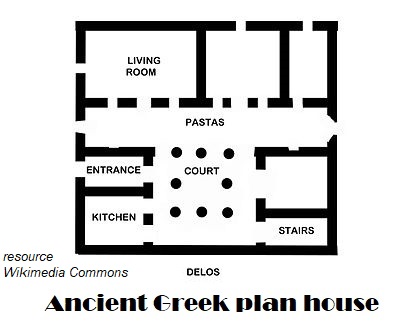
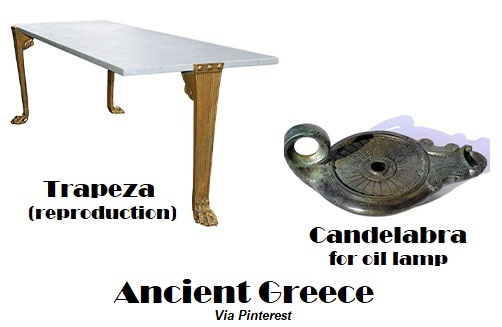
A house layout could differentiate by size and complexion, but on its base was the classical planning (example see typical Olympian house). The compositional core of a residential house was its courtyard, usually located on the south side of the building plot. On the north side were placed living rooms and in front of them a porch. Sometimes, a porch was surrounding the courtyard from two or even from three sides. A Greek home would have a main entrance room – the andron, used for festivities; a residential part, with main room oikos which served as a family dining room; and finally, storage and servant rooms. Sometimes andon was called “men room” because during on celebrations women were not participating. Dining tables (trapeza) were low due to the habit of eating lying down. After each course, slaves/servants were bringing bowls with clean water to wash hands, since ate with their bare hands.
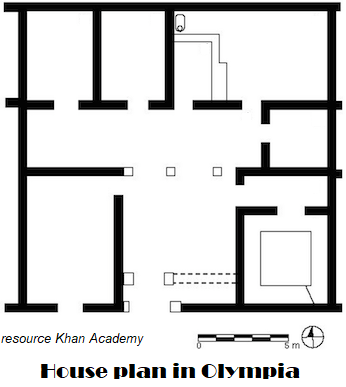
The main documentation we have today on residential architecture is from the Classical period, like residues found in Olympia, constructed around V-IV centuries BC. Basic building principles in Olympia, like in other Greek cities of that period, was democratic: same size plots to all developers. The city had a regular planimetry with straight streets intersecting at perpendicular angles and dividing the city into residential districts. These districts were sized to residential houses 19 by 20 meters.
However, in the Helenian epoque, urban planning and constructions got a notable improvement. The urban infrastructure differentiates with construction of well-to-do central quarters with regular planning for wealthy citizens, and poor periphery planning for artisans and poor citizens. An increased differentiation of wealth inequality introduces a new scale, majestic private homes measuring half-a-district or even covering an entire block. Individuality and personal interest manifested in society lead to increased attention towards private home luxurious decorations. Followed a change in structure and volume of residential buildings.
Widely diffused becomes the construction of peristyle house, which was also centered on a wide passage which ran the length of the house and opened at one side onto a small courtyard which admitted light and air. Larger houses had a fully developed peristyle (courtyard) at the center, with the rooms arranged around it. The ground floor rooms would have included a kitchen and storage rooms, while quarters for women and children could be located on the second level (if present) and were, in any case, apart from the mens’ area.
“House of the Masks” in Delos, built around 150-100 BC, takes its name from floor mosaics featuring actors' masks, although the centerpiece is a spectacular mosaic of Dionysus riding a leopard, flanked by two centaurs. The House of Masks consists of four buildings. In the center of the courtyard was a large pool, carved in natural granite, supplied water to the block of houses. This luxurious house was decorated with exceptional mosaics and frescoes, luxury vessels, gold, jewels, and statues.
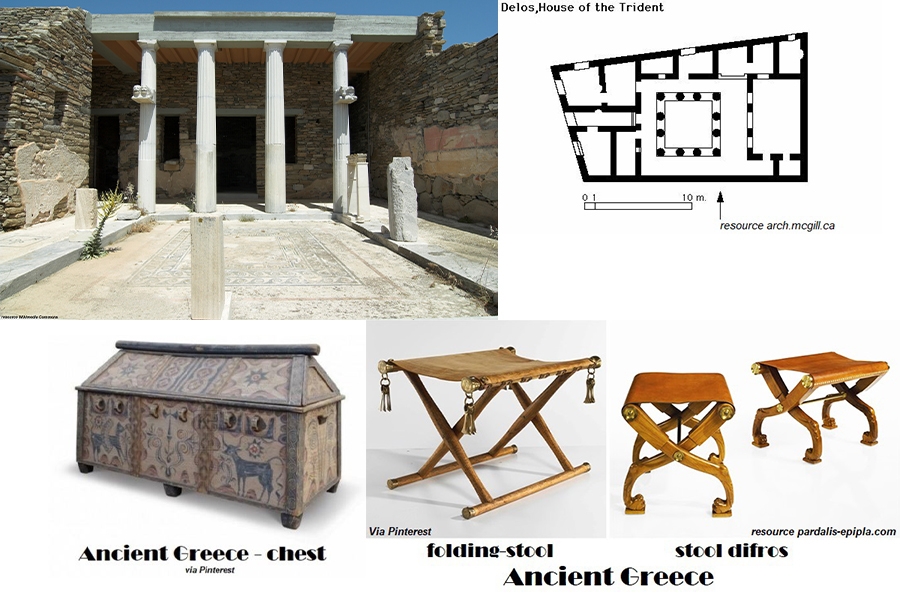
Another luxurious villa was the “House of the Trident” in Delos, built around 150-100 BC. It contains peristyle panels with the motif of a black dolphin situated around a red anchor and black tridents against a white background. A house with peristyle court, irregularly shaped, with main door on the west leading to a large central courtyard with Doric columns and a cistern for rainwater beneath. Positioned in the theater quarter on the road of the theater.
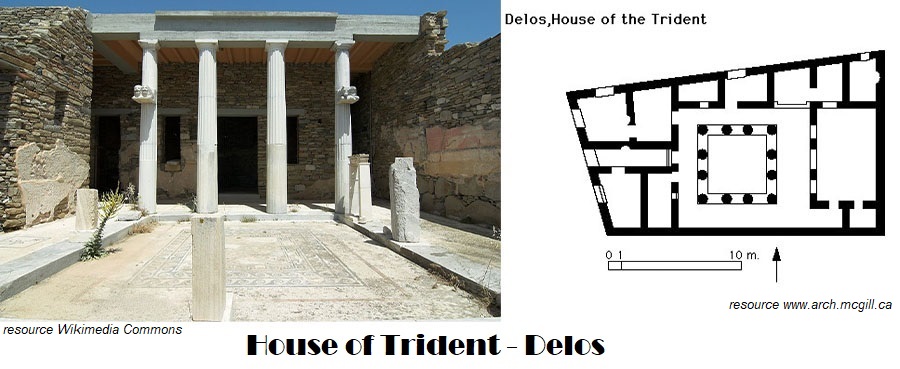
Architectural elements were concentrated on internal courtyard and decorations, such as furnishings, lighting fixtures, textiles, ceramics, jewelry, were all brought into one stylistic unity. Moreover, walls could be painted with mythological scenes and ornamented with classical decorative order, while floors were enriched with mosaics figures and geometric-patterned motifs. Under eastern influence, in interior decoration entered carpets, which covered the floors of the living rooms.
City houses were built with adjoining walls and were divided into small blocks by narrow streets. Shops were sometimes located in the rooms towards the street. They were inward facing, with major openings looking onto the central courtyard, rather than the street.
Ancient Greek furnishings:
Greek furnishings, unlike more ancient Egyptian, were not preserved until our days (with a few exceptions made in marble and bronze). However, we know well enought from relief images, painted vases and literary sources preserved.
Greek carpenters and artisan furniture makers owned the technology of frame-panel knitting, bending/curving wood under steam, inlaying, wood and marble turning. It was in Ancient Greece that we found the first jointer or planer (which is a woodworking tool used to produce a flat surface along a board's length).
Main wood species implied for the furniture production were maple, walnut, cedar, boxwood, plum, ebony. Exceptionally was used bronze (well-preserved remained an antique bronze bed dated IV century BC found in Priene, an ancient Greek city of Ionia, nowadays Turkey) and marble (mainly for tables and altars).
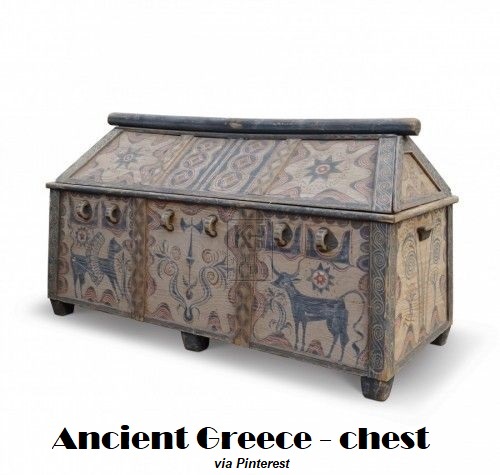
The quantity and types of furnishings in Greek homes, particularly in the Antique and Classical periods, was reduced to minimum. As storage units and wardrobes for clothing were used chests on small legs and with gable cover for opening, like models used in Ancient Egypt. Walls of such chests may have been covered with ornamental painting or inlay details in wood.
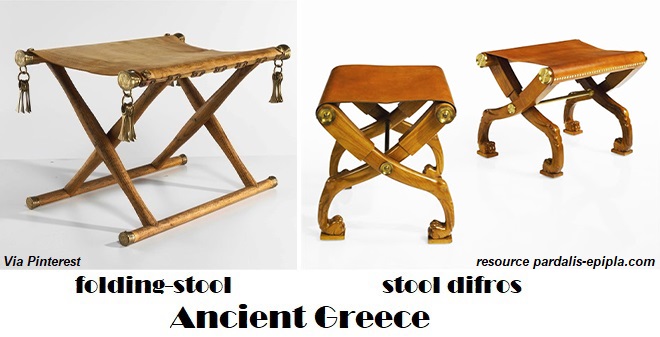
As sittings ancient Greeks were using stools, chairs, and armchairs. Widely used was a type of stool with four chiseled legs thinning at the bottom, called difros. From the Ancient Egypt was borrowed the folding stool with X-type legs.
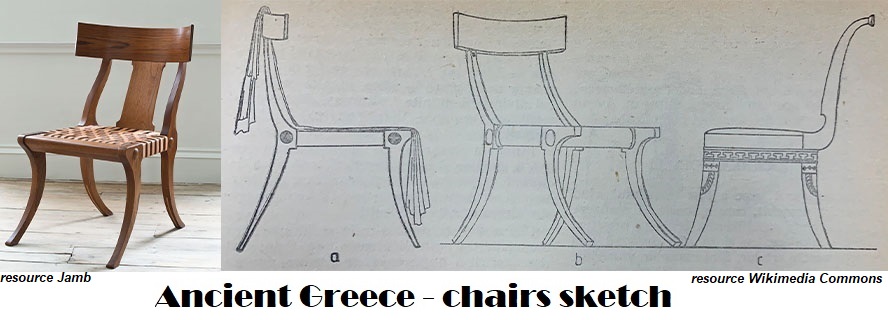
But the most popular Greek furniture had chairs klismos. It was distinguished by gracious and elegant design, having front and back legs curved and an ergonomically curved backrest. These chairs were made from bending wood and fixed at joints with metallic brackets and wood overlays. Simpler models could also be found, with vertical legs and animal paws.
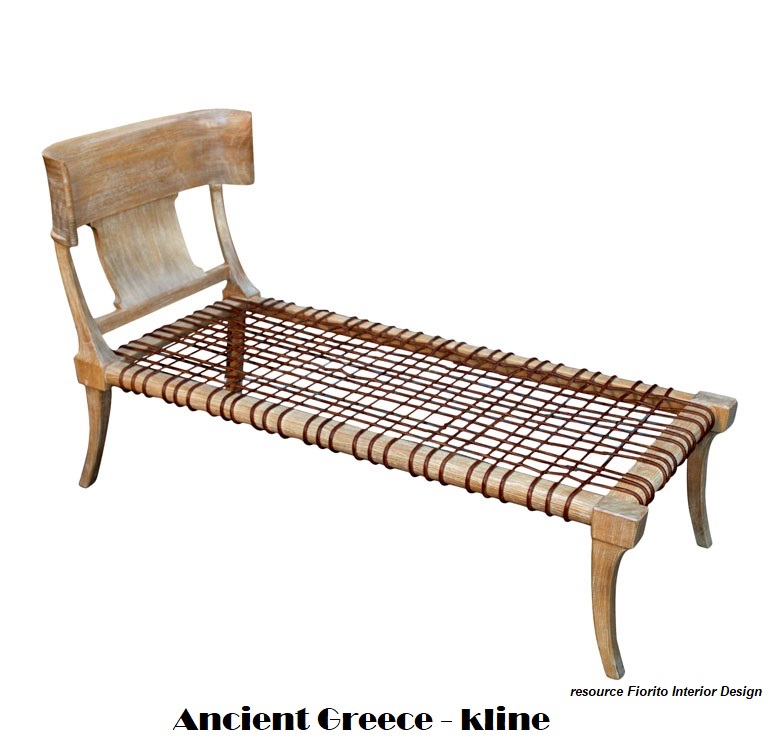
Chaise-longue kline were quite unconventional, with straight legs height about 1 meter, two of them arriving much higher to work as a headboard, place pillows on top. Sometimes kline were padded with pillows to make them softer and more comfortable.
Dining table (trapeza) was quite low and portable. Trapeza could be rectangular or rounded, on three or four legs, sometimes on one central base. Oftenly these legs had animal paws at the end. Besides wood, sometimes to make smaller tables was used bronze. Always bronze was used to make candelabra for oil lamps and cylindrical jars for keeping small objects.
Best wishes,
Nadiya
MetropolitanMe Blogger