

Parthenon is the most important surviving building of Classical Greece, a peripteral octastyle Doric temple with Ionic architectural features measuring at the base 30.9 to 69.5 meters. There are 8 columns at either end ('octastyle') and 17 on the sides. There is a double row of Doric columns at either end. In total counting 46 outer columns, each being 6 feet in diameter (1.9 meters) and 34 feet tall (10.4 meters). Inside were other 23 inner columns, each column having 20 flutes (the concave shaft carved into the column form). The roof was covered with large overlapping marble tiles.
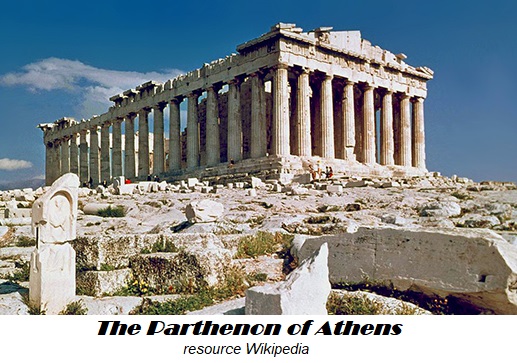
The colonnade surrounds an inner structure (cella) 29.8 meters long by 19.2 meters wide (97.8 × 63.0 ft), which is divided into two compartments with entrances from the opposite sides of the temple. The inner chamber contained a large gold and ivory statue of Athena.
Pericles used to say “beauty without whimsy and wisdom without frills”. Parthenon was the statement of beauty standards of those times. Along with it, here we could already observe the tendency to mix orders styles, leading in classical period to the joint application of all three orders together.
After Parthenon, Greek architecture started a tendency to elaborate and personalize better cultural interiors. The Temple of Apollo Epicurius designed by Iktinos and constructed between 450 BC and 400 BC, is one of the most studied ancient Greek temples because of its multitude of unusual features:
- Unusual is that the temple is aligned north-south, in contrast to the majority of Greek temples which are aligned east-west; its principal entrance is from the north.
- Moreover, it has examples of all three of the classical orders used in ancient Greek architecture: Doric, Ionic, and Corinthian. Doric columns form the peristyle while Ionic columns support the interior and a single Corinthian column features in the centre of the interior (cella).
- Unseen before was the fact that the interior room (cella) has not one, but two entrances, from south and west.
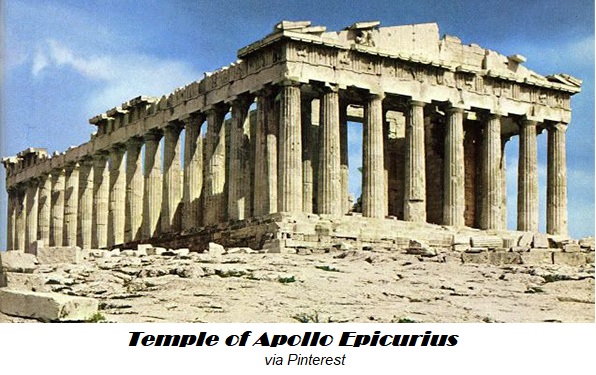
Externally being the classical peripteral hexastyle, with the stylobate measuring 38.3 by 14.5 metres, containing a Doric peristyle of six by fifteen columns (hexastyle). The roof left a central space open to admit light and air. The temple was constructed entirely out of grey Arcadian limestone except for the frieze which was carved from marble. Like many major temples it has three "rooms": a pronaos, a naos and an opisthodomos.
An increasing tendency to personalize the composition of Greek temples has reached a new level with the construction of Erechtheion / Erechtheum during 421-407 BC, an ancient Greek temple on the north side of the Acropolis of Athens in Greece which was dedicated to both gods Athena and Poseidon.
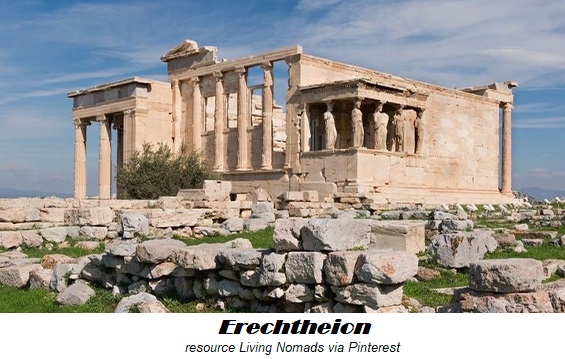
Its planimetry and composition is unique and had no analogs because of the relief it is built on. The entire temple is on a slope, so the west and north sides are about 3 m (9 ft) lower than the south and east sides. It was built entirely of marble from Mount Pentelikon, with friezes of black limestone from Eleusis and sculptures executed in relief in white marble. It had elaborately carved doorways and windows, and its columns were painted, gilded, and highlighted with gilt bronze and multi-colored inset glass beads.
The complex asymmetric design fits naturally. The entire structure consists of four compartments divided in two parts, explained by the fact it had to preserve two deities, Athena on the east side and Poseidon on the west side. The largest room being the east cella with an Ionic portico on its east end. The entire interior at the lower level and the East porch used for access to the great altar of Athena via a balcony and stair, was used also as a public viewing platform. To access the cella of Posseidon was needed to walk all around the temple, feeling all the way the perspective change.
In the Hellenistic period started to appear several other types of constructions, which was influenced by an introduction of new cultures. Instead of temples, started to raise independent constructions, such as altars (es. The Altar of Zeus at Pergamon c. 200-150 BCE).
The Corinthian order was used not only on internal decorations, but also on the outside facades, creating external porticos. The first dateable and well-preserved presence of the Corinthian temple is the Temple of Olympian Zeus or the Olympieion of Athens, planned and started between 175–146 BCE. This mighty dipteros with its 110 × 44 m substructure and 8 × 20 columns was to be one of the largest Corinthian temples ever.
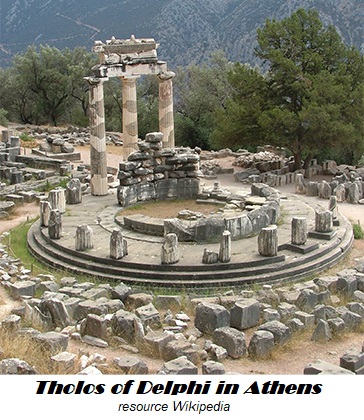
Circular temples (tholos) also received new compositional modifications. The Arsinoe Rotonda, also known as the Arsinoeion, built between 288 and 270 BC, was a large 20.2 metres in diameter, the largest ancient Greek rotunda. The cylindrical walls were decorated externally with 44 engaged Doric pilasters holding a conical roof. Inside the building, in place of the external pilasters was a colonnade of Corinthian half-columns.
During the Hellenistic period, a particular expansion receives Ionic Dipterals of huge sizes. The ancient Greek temples developed from small mud brick structures into double-porched monumental "peripteral" buildings with colonnade on all sides, often reaching more than 20 meters height (not including the roof). The cella of such huge constructions often remained uncovered, becoming into an open-air courtyard.
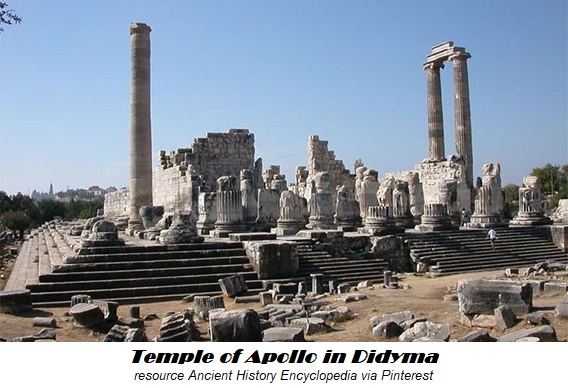
The Temple of Apollo in Didyma, also known as Didymaion (c. 313-163 BCE), situated on the coast of Ionia in the domain of the famous city of Miletus, a short distance to the northwest of modern Didim in Aydin Province, Turkey (once territory of the Ancient Greece). It was the home dedicated to the twins Apollo and Artemis, well renowned in antiquity because of its famed oracle Apollo. It was probably a hekatompedos, which means 100 feet long, and width of this first sekos measured 10 meters. 'Sekos' is Greek for ‘courtyard’; we can therefore deduce that the late geometric temple and its successors had never been roofed. In cella was not placed the deity statue like used to do in classical periods, but a small Ionic Prostyle Temple, inside of which was kept the antique bronze statue of Apollo.
Best wishes,
Nadiya
MetropolitanMe Blogger