
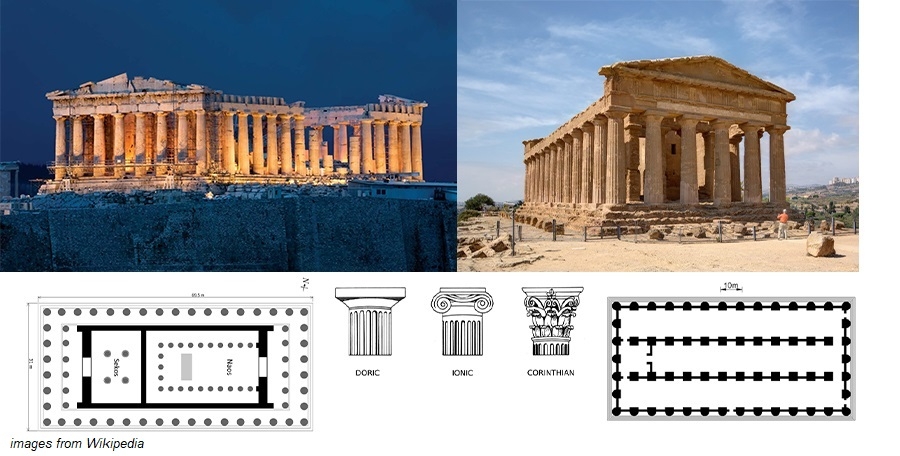
Ancient Greek architecture is best known from its temples, many of which are found throughout the region, and the Parthenon is a prime example of this, mostly as ruins but many substantially intact. The second important type of building that survives all over the Hellenic world is the open-air theatre, with the earliest dating from around 525–480 BC. Other architectural forms that are still in evidence are the processional gateway (propylon), the public square (agora) surrounded by storied colonnade (stoa), the town council building (bouleuterion), the public monument, the monumental tomb (mausoleum) and the stadium.
*There are five orders of classical architecture – Doric, Ionic, Corinthian, Tuscan, and Composite – all named as such in later Roman times. Greek architects created the first three and hugely influenced the latter two.
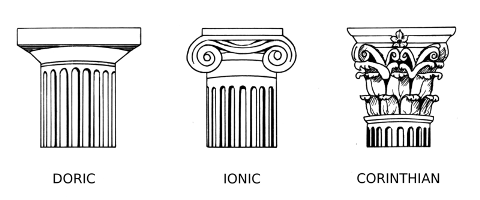
Ancient Greek architecture of the most formal type, for temples and other public buildings, is divided stylistically into three Classical orders, first described by the Roman architectural writer Vitruvius. These are: the Doric order, the Ionic order, and the Corinthian order, the names reflecting their regional origins within the Greek world. While the three orders are most easily recognizable by their capitals, they also governed the form, proportions, details and relationships of the columns, entablature, pediment, and the stylobate.
These styles (also called "orders") were reflected in the type of columns they used:
- Doric columns were the simplest and the thickest of the Greek styles. They had no decoration at the base and a simple capital at the top. Doric columns tapered so they were wider on the bottom than at the top. Are almost always cut with grooves, known as "fluting", which run the length of the column and are usually 20 in number, although sometimes fewer. Example: Temple of Hephaesthos, Athens.
- Ionic columns were thinner than the Doric and had a base at the bottom. The Ionic order is recognized by its voluted capital, in which a curved echinus of similar shape to that of the Doric order, but decorated with stylized ornament, is surmounted by a horizontal band that scrolls under to either side, forming spirals or volutes like those of the nautilus shell or ram's horn. In plan, the capital is rectangular. It is designed to be viewed frontally but the capitals at the corners of buildings are modified with an additional scroll to appear regular on two adjoining faces. Caryatids, draped female figures used as supporting members to carry the entablature, were a feature of the Ionic order, occurring at several buildings including the Siphnian Treasury at Delphi in 525 BC and at the Erechtheion, about 410 BC.
- Corinthian is the most decorative of the three orders. The Corinthian order does not have its origin in wooden architecture. It grew directly out of the Ionic in the mid-5th century BC and was initially of much the same style and proportion but distinguished by its more ornate capitals. The capital was decorated with scrolls and the leaves of the acanthus plant. Being shaped like a large krater, a bell-shaped mixing bowl, and being ornamented with a double row of acanthus leaves above which rose voluted tendrils, supporting the corners of the abacus, which, no longer perfectly square, splayed above them. The Corinthian order was initially used internally, as at the Temple of Apollo Epicurius at Bassae (c. 450–425 BC). In 334 BC it appeared as an external feature on the Choragic Monument of Lysicrates in Athens, and then on a huge scale at the Temple of Zeus Olympia in Athens, (174 BC–132 AD). The Corinthian order became popular in the later era of Greece and was heavily copied by the Romans.
Moreover, the architecture of ancient Rome grew out of that of Greece and maintained its influence in Italy unbroken until the present day. From the Renaissance, revivals of Classicism have kept alive not only the precise forms and ordered details of Greek architecture, but also its concept of architectural beauty based on balance and proportion. The successive styles of Neoclassical architecture and Greek Revival architecture followed and adapted ancient Greek styles closely.
Temples are the most important and most widespread building type in Greek architecture. The rectangular Temple is the most common and best-known form of Greek public architecture. The Mycenaean megaron (15th to the 13th century BCE) was the precursor for later Archaic and Classical Greek temples. The temple was a simple rectangular building with side walls (antae), forming a small porch. This temple contained a central throne room, vestibule, two wood columns and porch at the entrance. First temples had walls made mostly of mud and brick and were placed on stone foundations. The columns and superstructure (entablature) were wooden, door openings and antae were protected with wooden planks. First, wooden columns were thinner and were placed more distant one from another. Later, when columns started to be made of stone or marble, the proportions and distance changed, accounting to the properties of the new materials.
Stone columns were unnecessarily heavyweight, but closer to the V century BCE in Greek architecture have been achieved perfect proportions of the stone order system. To stress the importance of the cult statue and the building holding it, the naos was equipped with a canopy, supported by columns. The resulting set of colonnades surrounding the temple on all sides (peristasis) was exclusively used for temples in Greek architecture.
In Ancient Greece temples were treated as houses of gods. However, the temple did not serve the same function as a modern church, since the altar stood under the open sky in the temenos or sacred precinct, often directly before the temple. Temples served as the location of a cult image and as a storage place or strong room for the treasury associated with the cult of the god in question, and as a place for devotees of the god to leave their votive offerings, such as statues, helmets, and weapons. Some Greek temples appear to have been oriented astronomically. The temple was generally part of a religious precinct known as the acropolis.
Study of the soils around temple was made to choose regarding particular deities: for example, amid arable soils for the agricultural deities Dionysos and Demeter, and near rocky soils for the hunter deities Apollo and Artemis.
Greek temples were grand buildings with a fairly simple design. The outside was surrounded by a row of columns. Above the columns was a decorative panel of sculpture called the frieze, where a common theme was battle scenes of all kinds. Above the frieze was a triangle shaped area with more sculptures called the pediment. The roofs were crowned by acroteria, originally in the form of elaborately painted clay disks, from the 6th century BCE onwards as fully sculpted figures placed on the corners and ridges of the pediments. They could depict bowls and tripods, griffins, sphinxes, and especially mythical figures and deities. Inside the temple was an inner chamber (cella) that housed the statue of the god or goddess of the temple.
The foundations of Greek temples could reach dimensions of up to 115 by 55 m, which is the size of an average football pitch. Columns could reach a height of 20 m. The main measurement was the foot, varying between 29 and 34 cm from region to region. Important factors include the lower diameter of the columns and the width of their plinths. These measurements were in set proportions to other elements of design, such as column height and column distance. The basic proportions of the building were determined by the numeric relationship of columns on the front and back to those on the sides. The classic solution chosen by Greek architects is the formula "frontal columns : side columns = n : (2n+1)".
Access to the naos (cella) of a Greek temple was limited to the priests, and it was entered only rarely by other visitors, except perhaps during important festivals or other special occasions. It was typically necessary to make a sacrifice or gift, and some temples restricted access either to certain days of the year, or by class, race, gender (with either men or women forbidden), or even more tightly. Garlic-eaters were forbidden in one temple, in other women unless they were virgins; restrictions typically arose from local ideas of ritual purity or a perceived whim of the deity.
The centerpiece was the cult image normally in form of a statue of the deity, tall from the ground to the ceiling, in early days made in wood, marble or terracotta, or in especially prestigious temples using ivory plaques for the visible parts of the body and gold for the clothes, around a wooden framework. The cult statue was often oriented towards an altar, placed axially in front of the temple. To preserve this connection, the single row of columns often found along the central axis of the naos in early temples was replaced by two separate rows towards the sides. When the temple had three aisles it often had also an upper floor making possible to walk around the statue. The huge contrast in sizing between the statue of deity and other decorative statues and elements was made to emphasize the importance of the deity itself.
Often, the only source of light for naos and cult statue was the naos's frontal door, and oil lamps within. Thus, the interior only received a limited amount of light. For cultic reasons, but also to use the light of the rising sun, virtually all Greek temples were oriented with the main door to the east (with a few exceptions). Cella in the biggest temples could also have hypetral openings (holes) in the ceiling; in such temples one or more roof sections were missing; other times the entire roof above the cella was missing, transforming it into an inner patio inside the temple itself.
Flooring was usually covered in stone. Very often could be seeing floors of altering dark and light stone slabs, but also mosaics made of colored stones and pebble-stones inserted in a binder solution. Ornamental and figurative compositions were laid out in the mosaic technique. Sometimes was covered with colored knock, like in the Aegina Aphaia Temple, Athens.
Walls were usually covered with plaster and painted. Unfortunately, no Ancient Greek temple walls were preserved to our days, but according to various literary sources, we know, that in some temples were painted real historical pictures, placed in the form of parallel horizontal planar friezes.
The roofs were crowned by acroteria, originally in the form of elaborately painted clay disks, bur then, from the 6th century BCE onwards, as fully sculpted figures placed on the corners and ridges of the pediments. They could depict bowls and tripods, griffins, sphinxes, and especially mythical figures and deities. To emphasize the order and particular details were using bright colors – blue, red, and yellow, sometimes also black and white – to paint decorative details, both on the inside as on the outside.
The temple rises from a stepped base or stylobate, which elevates the structure above the ground on which it stands. Early examples, such as the Temple of Zeus at Olympus, have two steps, but the majority, like the Parthenon, have three, with the exceptional example of the Temple of Apollo at Didyma having six. The core of the building is a masonry-built "naos" within which is a “cella”, a windowless room originally housing the statue of the god. The “cella” generally has a porch or "pronaos" before it, and perhaps a second chamber or "antenaos" serving as a treasury or repository for trophies and gifts. The chambers were lit by a single large doorway, fitted with a wrought iron grill. Some rooms appear to have been illuminated by skylights.
Each temple is defined as being of a particular type, with two terms: one describing the number of columns across the entrance front, and the other defining their distribution. In the ancient period were formed the main types of Greek temples, which will be used during the entire classical epoque: anta, prostyle, amphiprostyle, peripteral, dipteral, monopteral, tholos.

Anta temple describes a small temple with two columns at the front, which are set between the projecting walls of the pronaos or porch, like the Temple of Nemesis at Rhamnus. This is the simplest type of temple, almost repeating by word the planimetry of a Mycenaean Megaron. A rectangular construction containing a porch with two columns at the entrance (pronaos), forming a vestibule within two lateral walls, and a central throne room (cella). The Megaron will form the base to other types of temples, which furtherly evolved by size and decorative architecture.
Prostyle was created by adding other two column at the entrance porch, now having a total of four.
By doubling the prostyle porch, one at front and one at the back, was created the Amphiprostyle type of temple. Has columns at both ends which stand clear of the naos. Tetrastyle indicates that the columns are four in number, like those of the Temple on the Ilissus in Athens or Temple of Athena Nike, built in Ionic order.
When the naos (cella) is surrounded on perimeter by a row of columns, the temple takes the name of peripteral. The combination of the temple with colonnades (ptera) on all sides posed a new aesthetic challenge for the architects: the structures had to be built to be viewed from all directions. This led to the development of the peripteros, with a frontal pronaos (porch), mirrored by a similar arrangement at the back of the building, the opisthodomos, which became necessary for entirely aesthetic reasons.
Peripteral hexastyle describes a temple with a single row of peripheral columns around the naos, with six columns across the front, like the Theseion in Athens.
Peripteral octastyle describes a temple with a single row of columns around the naos, with eight columns across the front, like the Parthenon, Athens.
The aspiration to further enrich the facades by adding more elements takes to the creation of a new type of temples named dipteral. In this case, the naos (cella) will be surrounded by a double row of columns.
Dipteral decastyle describes the huge Temple of Apollo at Didyma, with the naos surrounded by a double row of columns, with ten columns across the entrance front.
The Temple of Zeus Olympius at Agrigentum, is termed Pseudo-periteral heptastyle, because its encircling colonnade has pseudo columns that are attached to the walls of the naos. Heptastyle means that it has seven columns across the entrance front.
Less common were circular temples referred to as tholos. The naos (cella) was circular and surrounded on perimeter by a row of columns, like the Tholos of Delphi in Athens.
Most ancient Greek temples were rectangular and were approximately twice as long as they were wide, with some notable exceptions such as the enormous Temple of Olympian Zeus, Athens with a length of nearly 2½ times its width. The smallest temples are less than 25 metres (approx. 75 feet) in length, or in the case of the circular tholos, in diameter. The great majority of temples are between 30–60 metres (approx. 100–200 feet) in length. A small group of Doric temples, including the Parthenon, are between 60–80 metres (approx. 200–260 feet) in length. The largest temples, mainly Ionic and Corinthian, but including the Doric Temple of the Olympian Zeus, Agrigento, were between 90–120 metres (approx. 300–390 feet) in length.
Among all, the most famous temple of Ancient Greece is the Parthenon, while the most studied temple is the Temple of Apollo Epicurius. About this and other majestic temples of Ancient Greece will see in the folowing post.
Best wishes,
Nadiya
MetropolitanMe Blogger