

The territory that has developed the most distinctive style in the ancient east period was the Cretan architecture. The highest achievements in its development happened in the XVIII-XV centuries B. C. when several tribes living in Crete have united under one naval fleet, becoming the biggest and most powerful fleet in the Mediterranean waters. In this period, there has been a boom in the construction of big cities, which here on Crete were counting more than one hundred. In Crete, towns had no fortifying walls. Their planimetry stands out by its asymmetry, along with living spaces. The residence spaces were made of two or three floors, with a flat rooftop also used as a terrace. To construct, they were using clay masonry for the ground floor, while the upper floors were using a mixture of raw and burnt bricks. In the first constructions, there was no fixed fireplace planned, so people were using portable braziers. The differences in structure and construction materials used were covered with a layering of lime plaster, usually painted white or red. For detailing, they were using black, yellow, and light blue paintings.
The houses of the rich had an internal courtyard, surrounded by arcades and columns. The interior walls were covered with a plaster layer (a marble effect on the surface), painted with decorative paintings on top and with inserts in blue enamel placed on the joints between stone tiles.
Their splendor greatness distinguished palaces. Among these, the significant impact was the magnificent Palace of Knoss, in Crete's capital city. It was reconstructed several times during the XVII-XV centuries B. C. Nevertheless, its extension with additional new rooms and the variation of their functionality, left untouched the base of the palace. It was subsequently elaborated in the smallest details in architecture and decorative details.
The Palace of Knossos was oriented on the four parts of the world and was occupying a total surface of 100 x 100 meters. Unlike palaces from the Ancient East, the sizes of the external architecture were not playing the primary role because was not perceived as a whole piece, but rather as a living organism that is continuously evolving and growing on the Knoss body. The accent is shifted to the internal parts of the palace, where its center was a great central courtyard (as it was happening to the most palaces in Crete).
The West section was opening towards the central courtyard through an extended front porch with columns and was made from a first floor containing narrow rooms used as warehouse storage units and different closets (or a regular planimetry), while on the second and third floor were placed rooms for ceremonies and religious purpose, picturesque and projected on an asymmetric planimetry.
The Eastern part, incorporated into the slope of a hill, was directly opening toward the inside courtyard from the upper floor. On the lower floor, the one that was bellow the courtyard level was situated the accommodations with living rooms and dining rooms, bedrooms, and bathrooms. The intern spaces of these rooms received direct natural lighting arriving from the central courtyard or otherwise illuminated by the small slots of the wells, where they usually passed the staircases.
On the North-West, the palace was opened to the Theatre square with stone staircases, made for the audience, planned of course for essential meetings and theatrical spectacles and cultural activities.
From the South-West side was arriving a stepped porch – in the plant is indicated as a long and interrupted flight of steps, rising to the hill and framed by the presented columns, on which was placed a flat upholstery of steps (the reclined lines were unknown to the Cretan architecture).
The entrances in the palace were situated in the western and northern parts. As well as the external architecture of the palace, entrances were made of simple arcades, lacking any monumental decorations that were instead so characteristic to the Egyptian and Mesopotamian constructions. To arrive at the central courtyard, the visitor must have been changing several times the path direction, following different turns, corridors, and staircases (like a labyrinth).
The palace's structural composition is a picturesque space with no suite apartment, while all the rooms are opening one into another, creating a perspective of continuous movement. On the inside, the energy flows freely on the horizontal plane and on the vertical thanks to the presence of many staircases (some of them straight and with turns, other wide and straight), changing by a step or two the space plan. Walking inside the palace, a visitor was pleasantly surprised by a series of elements: enlightened porches followed darkened rooms; a narrow hall opens to a large patio. While going upstairs or downstairs on the staircases, new accesses opened to new rooms or opened new perspectives to the rooms already seen. Like the Egyptian temples of the New Reign, internal spaces were projected to create different sensations and arouse emotions, besides the apparent visual interest and beautiful art. The main difference was the path of the part, which in Egypt was meant to follow a specific trajectory, e defined orientation. In contrast, in the majority parts of the Palace of Knoss, the path was left at the discretion of the visitor, which could walk in any direction at any time. The emotions you receive by walking inside the walls of this palace are unforgettable, and it is only accentuated by the freedom to walk and explore the architectural composition.
The Palace of Knossos accounts for its magical beauty to the intelligently well-played contrast combination of light and shadows. The shadow transforms into darkness as further you go from the courtyards, the only existing source of natural light, for all the rooms of the palace. This conditioned the color choice in the rooms: as further a place was positioned from the lighting source, the darker these become, and accordingly, the lighter were the color choices for paint. Walls were usually refined with a layer of plaster, and afterwar painted or decorated with paintings. The preferred colors to paint the walls we white and red. The base for columns was painted usually red, while the capitals were black.
It was the use to paint mostly portraits of nature, representing it ostentatiously. Walls were decorated with portrait scenes of different trees, plants and flowers, birds, and the sea with its inhabitants (fishes, crabs, octopus, starfish), people in several poses, during sporting competitions, executing religious ceremonies or while carrying gifts to their sovereignty. No matter the theme, these paintings were executed with the maximum expression and cure to details without any predefined fees and a high decorative expression and color use. In paintings, they were following no particular order or sequence of the scenes. Oftenly, the ornaments were recalling to a state (a moment) in time, where the form was in continuous mutation – the tentacles of an octopus, the footsteps of a wave, and so on.
The history of arts has frequently drawn stylistic parallels between the art in the Ancient Crete and the design style Roccocò. In both cultures, distant thousands of years can be observed external analogies. Here are some examples: female clothing made of a tight corset, a profound decolté, slightly enlarged on the bottom, and the love for the winding lines on furnishings and decorative objects. This way, the Throne made of stone (certainly repeating the forms of wood furnishings) was close to the styles applied in rococo, with a graduate transition of internal lines, shrinking gradually on the base, at feet curved lines were embracing and framing the backrest.
The room where the Throne was hold (let’s call it The Throne Chamber) has an asymmetric planimetry. Symmetrical elements were required only for the front wall, placing painted griffins protecting the centrally positioned Throne in stone. Going through a porch with two asymmetric columns from the Throne Chamber, you arrive in an enlightened patio with staircases going downstairs to the ritual pool. Always asymmetrical was positioned the main entrance, that was placed aside from the Throne. Compared to the extreme solemn rooms of the Assyrian-Babylonian monarchs, this was rather a welcoming room meeting guests, without evidentially distinguishing it from the rest of the palace. You could pass by to the next rooms without any obstacles on the way.
All the internal spaces of the Palace of Knoss have elevated thanks to the columns positioned on the arcades, along the staircases, going straight towards the floor, and painted red. This type of column was very diffused in Crete. At the very beginning, these columns were made of wood, but after archaeological excavations of the palace in the Twentieth century, we could find out that several columns that columns in stone replaced burnet. The walls were build using raw bricks with wooden skeletons. The claystone was used to create the most critical structural elements, such as clogs, staircases, and structural walls.
Similar construction techniques and distribution of the spaces inside the palace were used to build other palaces in the Minoan Crete – at Gurnia, Feste, and Malia. We can also find the influences of this style in continental Greece, but rather in the architectonical elements and individual arts, such as columns that were restraining towards the floor, similar natural paintings, etc.
According to the basic compositional principles and living traditions, the architecture in Mycenaean Greece was differentiating from the Minoan Crete. Mycenaean people were used to building the monumental tomb of spherical shape. The most famous monument of such type was the Treasury Chamber Areat in Mycenae (also known as The Tomb of Agamemnon), dated XIV century B. C. The rounded chamber had a diameter of 14,5 meters (570,86 inches) and was closed with a false dome tall 13,2 meters (519,68 inches). In the joints between stone, slabs were inserted bronze rosettes to accentuate the rings' heights and make even more visible the big space available inside. On the outside, they poured a hill over the tomb to protect and create volume, while the access to the spherical room was made through a long-opened hall length 36 meters (1.417,32 inches) and wide 6 meters (236,22 inches). The entry door was height 5,4 meters (212,59 inches), framed by two half-columns in green marble decorated with metallic pieces, that were restraining on the bottom.
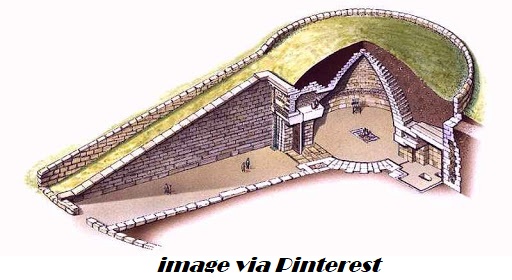
Unlike not fortified palaces built in Crete, and using a mix of different techniques in construction, the monumental Mycenae architecture had a long-time distinctive character. Here often were using the stone technique, including the cyclopic (had no binder mixture). Mostly was affirmed the stone technique which afterwards had a diffused usage in the construction of palaces in the Antique Greece.
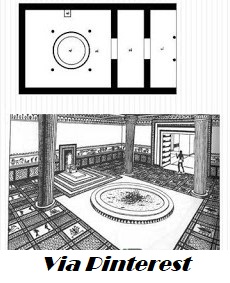
A great impact in the formation of the antique temple's planimetry had meragon houses (of the rectangular form) constructed by a room and a canopy, very diffused in the Aegean world (in Troy and Mycenae). In the center of the room was situated the fireplace (fixed, unlike houses in Crete), over which were creating a hole to allow the smoke to go out. If the room had bigger sizes, this would have been sustained by an additional four columns. In front of the megaron room were placed some canopy, formed by the prominence of the longitudinal walls, and the two columns situated between them. Temples of the Antique Greeks are repeating the planimetry of megaron. Moreover, the same concept of a megaron was used to create all the sumptuous entrances of the temples. It can be admired in the constructions of the Acropolis at Tirinifa and at Mycenae.
Best wishes,
Nadiya
MetropolitanMe Blogger