
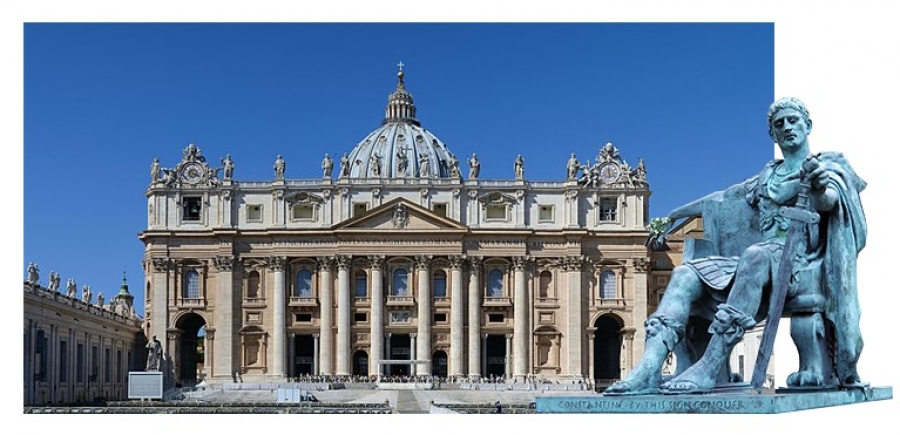
For much in the Middle Age and Renaissance, the Pope had the spiritual authority and the power over the Papal States, a large region in central Italy that included Rome. The political landscape changed dramatically in the 19th century. In 1870, the Kingdom of Italy captured Rome, effectively ending the Papal State. Therefore, Popes retreated to the Vatican area on the hill, refusing to leave or recognize the Kingdom of Italy's authority over Rome. The impasse was resolved in 1929 with the signing of the Lateran Treaty between the Holy See and the Kingdom of Italy. This agreement recognized Vatican City as an independent sovereign entity, giving the Catholic Church full control over the territory. The treaty also included the recognition of Catholicism as Italy's state religion and financial compensation to the Holy See for the loss of the Papal States.
Today, Vatican City is the smallest independent state in the world by both area and population. It serves as the spiritual and administrative center of the Roman Catholic Church and is the residence of the Pope. Its territory includes St. Peter's Basilica, the Sistine Chapel, the Apostolic Palace, and the Vatican Museums, among other sites.
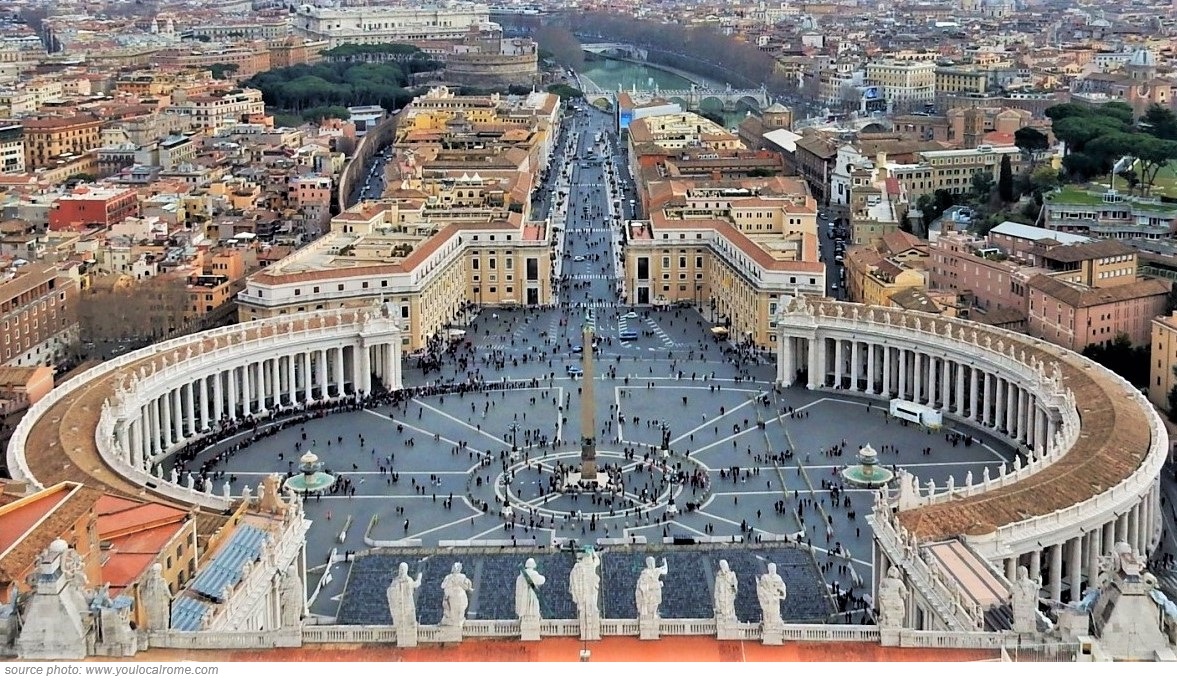
As you see, Vatican City with its rich history and religious significance, houses several areas that are surrounded by mystery and not readily accessible to the public. These "secret" places often fuel intrigue and curiosity.
There are some places we’ve heard of from different sources, such as:
- Vatican Secret Archives
The Vatican Apostolic Archive, commonly referred to as the Vatican Secret Archives, is one of the most confidential places in Vatican City. It houses the Church's vast collection of documents, including papal correspondence, historical records, and other documents that have been accumulated over centuries. Although it is known to be inaccessible, the Archives are actually opened to qualified scholars for research, with the exception of some restricted due to their delicate nature or the Vatican's privacy policies.
- The Vatican Necropolis
Beneath St. Peter's Basilica lies the Vatican Necropolis, a small city of the dead that includes mausoleums, monuments, and tombs dating back to the Imperial era. It is here that the Tomb of St. Peter is believed to be located. Access to the Necropolis is highly restricted, with visits allowed only by special permission.
- The Niccoline Chapel
La “Cappella Niccolina” is a chapel within the Apostolic Palace, decorated with frescoes by Fra Angelico in the 15th century. It served as a private chapel for Pope Nicholas V. Due to its significance and the fragility of the frescoes, the access is very limited.
- The Tower of the Winds
La “Torre dei Venti” is an observatory within Vatican City, built in the 16th century. It was used by the Gregorian Calendar Commission to study astronomical phenomena and to reform the calendar. The tower contains frescoes and scientific instruments from its time. It is rarely open to the public.
- The Borgia Apartments
Located within the Apostolic Palace, the Borgia Apartments were used by Pope Alexander VI. They are renowned for their beautiful Renaissance frescoes by Pinturicchio. While parts of the Apostolic Palace, including the Borgia Apartments, can be visited, access is typically restricted and requires special arrangements.
- The Sistine Chapel (After Hours)
The Sistine Chapel is one of the most famous sites in Vatican City. However, experiencing it without the crowds, during after-hours visits, offers a perspective that is almost secretive and much more intimate. These visits are highly exclusive and can be arranged through private tours.
- Gardens of Vatican City
The Vatican Gardens are an expansive area of the city-state that is generally closed to the public. They contain a variety of buildings, fountains, and sculptures, set among beautifully landscaped lawns and gardens. Access is possible through guided tours, which must be arranged in advance.
While some of these places are accessible to scholars or through special tours, they maintain an aura of mystery and exclusivity, contributing to the Vatican's allure as a place full of historical and spiritual secrets.
Nevertheless, always in the Vatican City we find the most revered and visited sites in the world, particularly for those interested in history, art, and religion. Here are the main tourist destinations within Vatican City that are generally open to the public:
- St. Peter's Basilica - One of the largest churches in the world and a supreme example of Renaissance architecture. The basilica is home to many masterpieces, including Michelangelo's Pietà and the grandiose Baldachin by Bernini over the papal altar. Visitors can also climb to the top of the dome for a panoramic view of Rome.
- The Vatican Museums - A vast complex of museums and galleries housing one of the most significant collections of art and artifacts in the world, including classical sculptures, Renaissance paintings, and Egyptian mummies.
- The Sistine Chapel - Famous for its magnificent frescoes by Michelangelo, including the iconic Creation of Adam on the ceiling and The Last Judgment on the altar wall. The Sistine Chapel is also where the conclave of the College of Cardinals is held to elect a new Pope.
- Vatican Gardens – Occupying more than half of the country's territory, this is a place of tranquility and beauty, with medieval fortifications, monuments, fountains, and beautifully landscaped gardens. Access is limited to guided tours, which must be booked in advance.
- St. Peter's Square - Designed by Gian Lorenzo Bernini in the 17th century, the large plaza located directly in front of St. Peter's Basilica is famous for its colossal Doric colonnades and the ancient Egyptian obelisk at its center.
- The Vatican Post Office is a unique destination. The Vatican has its own postal system and issues its own stamps, which are highly sought after by collectors. Sending a postcard from here can be a unique souvenir.
- The Vatican Library - Although it is not generally open for tourist visits, the Vatican Library is renowned as a research library that contains one of the world's most significant collections of historical texts. It occasionally hosts exhibitions where items from its collection are displayed to the public.
- The Apostolic Palace - The official residence of the Pope contains several chapels, galleries, and the Papal Apartments. While the Papal Apartments themselves are not open to tourists, parts of the palace, including some chapels and galleries, are accessible through the Vatican Museums.
Visiting Vatican City offers a unique blend of spiritual, artistic, and historical experiences. To make the most of a visit, it's advisable to book tickets in advance, especially for the Vatican Museums and the Sistine Chapel, as they can have long queues.
Vatican City is a treasure of intriguing stories, hidden details, and curious facts:
- Vatican City is the smallest country in the world, both in terms of area (approximately 44 hectares, or 110 acres) and population (around 800). Despite its size, it has its own postal system, radio station, and even a small railway station.
- Interestingly, the Vatican has its own economy, supported by the sale of postage stamps, souvenirs, museum admission fees, and publications. While it prints its own euros, Vatican euro coins are highly sought after by collectors.
- Responsible for the safety of the Pope is the Swiss Guard, known for their colorful Renaissance-era uniforms, is the smallest and one of the oldest standing armies in the world, responsible for the safety of the Pope. They have served as the papal bodyguards since 1506. Membership in the Swiss Guard is restricted to Swiss Catholic males.
- The Vatican offers a special tour known as the Scavi Tour, which takes visitors to the excavation site beneath St. Peter's Basilica. The site includes a Roman necropolis and is believed to be the resting place of St. Peter himself. These tours are known for being hard to book due to limited access.
- Vatican City is a country without children. It is also unique in that it has no permanent residents. Citizenship is granted to those who work in the city-state, including clergy and members of the Swiss Guard, and it is revoked when their employment ends.
- Established in 1931 by Guglielmo Marconi and commissioned by Pope Pius XI, Vatican Radio broadcasts all over the world in around 45 different languages. It serves as the Pope's voice to the global Catholic community and beyond.
- There is a hidden passageway named “Passetto di Borgo” that links the Vatican City to Castel Sant'Angelo on the banks of the river Tiber. This passage has been used by popes in times of danger to escape to the fortress.
- While Vatican City is a sovereign city-state, it doesn't have passport control at its entrances. However, accessing the main attractions like the Vatican Museums, St. Peter's Basilica, and the Sistine Chapel requires going through security screening.
These curiosities, along with its deep historical heritage, and natural beauty, makes Vatican City a truly remarkable place worth visiting!
Regards,
Nadiya
MetropolitanMe Blogger